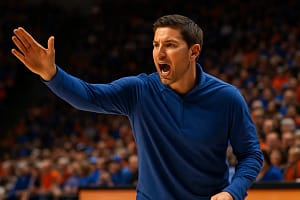
Florida can rehearse the pass, the cut and the late-clock shot. It cannot rehearse a judge’s decision. As of September 25, 2026, the Denzel Aberdeen eligibility case leaves Todd Golden preparing for two versions of his backcourt: one with another experienced creator, another with responsibilities that must move elsewhere.
Preseason expectations need that distinction. Even a fan browsing EveryGame sportsbook reviews should separate enthusiasm about Florida’s roster from certainty about who can play. The basketball question is not whether Aberdeen makes the Gators look deeper on paper. It is which possessions become harder without him.
Thomas Haugh’s return, alongside Alex Condon and Rueben Chinyelu, gives Florida familiar strength up front. But frontcourt talent still needs guards who can deliver the ball, punish defensive attention and keep an offense moving when its first option disappears.
Denzel Aberdeen Eligibility Remains Unresolved
Florida’s September 21 eligibility update identifies September 29 as the scheduled hearing date in Alachua County. Aberdeen’s attorneys are seeking a temporary injunction against the NCAA to secure a fifth season after his earlier petition was denied. He has been practicing, but practice is not clearance.
His challenge includes the limited role he played as a Florida freshman in 2022-23, when he appeared in 12 games. That helps explain his argument; it does not establish that the court will accept it. Nor should the hearing date be presented as a guaranteed final resolution.
For Golden, that distinction has practical consequences. A coach can install actions around a player during practice without knowing whether those combinations will be available in games. Preparing an alternative is not pessimism. It is part of getting the team ready.
Kentucky Changed What Aberdeen Could Offer
Aberdeen averaged 13.5 points and 3.4 assists for Kentucky in 2025-26. Earlier, he had averaged 7.7 points as Florida’s leading backcourt reserve during its 2025 national championship season. Those are different assignments, not simply different scoring totals.
A reserve can enter with a defined task: attack a matchup, defend aggressively, supply energy. A primary guard must also organize possessions when the opponent knows where the ball is going. Aberdeen’s Kentucky season gives Florida evidence of him handling that larger responsibility against SEC competition.
The relevant question is how much of that experience transfers into a complementary role. Florida would not need him to reproduce Kentucky’s offense. It would need him to make its own offense less dependent on one guard solving every problem.
Fland Would Gain Another Way Out
Boogie Fland returns with a season in Golden’s system behind him. Pairing him with Aberdeen would offer shared creation, not replacement: one guard could initiate while the other attacks a defense already shifting toward the ball.
Picture a possession with eight seconds remaining. The first screen produces no opening. A second capable handler can receive the next pass and attack immediately, rather than send the ball backward and ask the point guard to start again. That is where another creator earns his minutes.
There is a defensive consideration, too. Sharing offensive work could help preserve energy for ball pressure. None of this guarantees efficient possessions or a productive partnership. It describes the options Golden could test with both guards available.
His value could also show during Fland’s rest. Golden could keep an experienced organizer on the floor instead of asking a reserve unit to manufacture one. The test would be whether those groups still get the ball inside and create clean perimeter catches, rather than drifting into a series of isolated drives against a set defense.
Klavzar Makes the Alternative More Complicated
Urban Klavzar shot 40.6% from three-point range and earned SEC Sixth Man of the Year honors in 2025-26. He offers a credible alternative, but changing the starter changes the bench of Florida Gators.
Moving Klavzar into the first group would not erase his shooting. It would change when Golden introduces it and which teammates benefit. Staggering his minutes could preserve stretches against opposing reserves, although another player would still need to absorb responsibilities elsewhere.
That is why replacing Aberdeen cannot be reduced to putting the next name on a lineup graphic. Florida would need to distribute ball-handling, spacing and defensive assignments across whole units, not merely fill one position.
September 29 Is About More Than Five Starters
The next meaningful development is what the court actually orders, not how confidently anyone anticipates it. If Aberdeen gains permission to compete, attention can shift toward combinations and closing lineups. Without that permission, Golden must build around the players available.
The Denzel Aberdeen eligibility case is therefore about room to adjust. Florida has substantial talent either way. Aberdeen would give that talent another experienced offensive connection: someone who can help a possession survive its first setback. For a team chasing a championship, that is more valuable than a prettier depth chart.