Gators Roster Stability is not just a roster note in Gainesville. It is the difference between reacting to college sports churn and building a team that can practice, compete, and grow with purpose. As of August 28, 2026, Florida has two programs showing that theme in different ways: Jon Sumrall’s football team is blending major turnover with key holdovers, while Todd Golden’s men’s basketball program is leaning on continuity after a completed 2025-26 season that strengthened expectations around the O’Connell Center.
For a campus that understands how coaching identity can shape an athletic department, this is a meaningful moment. Stability does not mean every name stays forever. It means a staff knows which players set the tone, where depth is real, and how newcomers are folded into the daily work without weakening the locker room. That is where coaching becomes more than scheme. It becomes retention, standards, practice habits, and trust.
Why Gators Roster Stability Matters
Gators Roster Stability Starts With Holdovers
Florida football changed direction when Jon Sumrall was hired on December 1, 2025, but the program did not start from an empty room. The Gators retained five key holdovers from the previous staff: running back Jadan Baugh, receivers Vernell Brown III and Dallas Wilson, linebacker Myles Graham, and edge rusher Jayden Woods, according to the athletic department’s feature on five Gators who stayed. That group gave the new football staff something every coach wants during a transition: players who already understand the university, the league, and the weight of Saturdays in Gainesville.
Graham’s return is especially important because he led Florida with 76 tackles in 2025, per the same Florida athletics report. A junior linebacker with that production is not just a stat line. He is a meeting-room reference point, a practice tempo setter, and a player who can translate a new staff’s language to teammates still learning the system. In a transition year, those players often keep the floor from dropping.
Depth Is More Than A Two-Deep Chart
Depth is sometimes reduced to names on a chart, but coaches see it differently. Real depth means a team can survive injuries, handle practice competition, and avoid rushing young players before they are ready. It also means veterans feel pushed without feeling replaced. That balance is hard, especially when a football roster has both established players and a heavy wave of newcomers.
That is why Gators Roster Stability matters across the athletic department. It creates a path for development. A freshman does not need to carry the whole position room in September. A transfer does not have to become a captain in his first week. A returning starter does not have to explain every drill alone. The roster becomes healthier when leadership is shared.
Football Depth Under Jon Sumrall
Core Players Gave The First Staff A Base
Sumrall’s first football roster has been shaped by movement. The research available as of August 28, 2026, shows Florida added 24 freshmen and 34 transfers after his hiring, accounting for more than half of the scholarship roster. That much change can create energy, but it also tests communication. The holdovers become the bridge between what Florida was and what Sumrall is trying to build.
Quarterback is part of that stabilizing effort. On August 24, 2026, Aaron Philo, a transfer from Georgia Tech, was named QB1 for the scheduled September 5, 2026 opener against Florida Atlantic, while Tramell Jones Jr. remained in the mix. That decision did not remove all competition, but it gave the offense a clear starting point before game week. In a new staff’s first season, clarity at quarterback can sharpen receiver timing, protection calls, and practice reps.
Skill Talent Helps The Staff Manage Pressure
Florida also has evidence of depth at the skill positions. Pro Football Focus ranked the Gators’ running backs unit No. 4 nationally and placed the receiving corps among the top 15 in its 2026 Florida preview. Those rankings do not win downs by themselves, but they show that outside evaluators see more than one useful option in the backfield and receiver room.
That matters for Sumrall because an offense with multiple skill players can support a quarterback room that entered 2026 with limited total collegiate passing volume. The research notes Florida’s quarterback room brought 187 combined collegiate pass attempts: Philo with 102 at Georgia Tech, Warner with 50 in emergency duty in 2024, and Jones with 35 in 2025. That is not a veteran-heavy room, but it is not a blank page. Backs and receivers with depth can help reduce stress on the passer while the offense settles in.
The offensive line offers another picture of balance. Florida entered 2026 with 10 returners and 10 newcomers up front, with four returners who took snaps in 2025. Knijeah Harris, Caden Jones, Bryce Lovett, and Roderick Kearney formed part of that returning core. For any coaching staff, line depth is one of the hardest areas to build quickly. Returners can steady calls and technique standards, while newcomers add needed bodies for a long SEC schedule.
Basketball Continuity Under Todd Golden

Thomas Haugh Kept The Standard In House
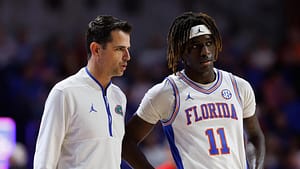
While football is managing a large reset, men’s basketball under Todd Golden shows another side of Gators Roster Stability. On April 21, 2026, forward Thomas Haugh reversed a decision to leave and returned to the program. The research identifies Haugh as Florida’s No. 2 scorer at 15.1 points per game and No. 2 rebounder at 7.5 rebounds per game. For Golden, keeping that type of player was about more than production. It preserved a voice who had already lived through the program’s standards.
That kind of return matters in a basketball locker room because rotations are tighter and chemistry can shift fast. A returning forward who scores, rebounds, and knows the staff’s expectations gives practices a more serious baseline. Young players can measure themselves against a proven teammate. Transfers can learn how Florida wants to run, communicate, and defend without every lesson coming directly from the coaches.
Depth Protects A Championship Standard
The 2025-26 Florida men’s basketball season is now complete as of August 28, 2026, and the roster picture from that campaign helps explain why Golden’s work has carried weight in Gainesville. The research notes the Gators entered that completed season with three returning players who had logged starter-level minutes and four more scholarship players who had contributed during the regular season. That is the profile of a team that was not forced into a full reset.
Basketball programs built around annual roster replacement can win, but they often spend the first months teaching every small habit from the start. Golden’s advantage has been the ability to pair new talent with players who already understand Florida’s pace, spacing, and defensive demands. For readers tracking Golden’s program arc, our feature on Todd Golden achievements connects that roster work to the larger rise of the program.
In Gainesville, continuity also changes the fan experience. Supporters recognize returning players. Students learn their games. Families coming to the O’Connell Center can connect one season to the next. That connection matters in college basketball, where player movement can make programs feel unfamiliar from November to March. Gators Roster Stability keeps the team’s identity easier to follow and easier to believe in.
What Gators Roster Stability Means For Florida
Coaches Build Trust Through Repetition
Stability and depth are often treated as separate ideas, but Florida’s 2026 picture shows how closely they are tied. Stability keeps leaders in place. Depth gives coaches choices. Together, they shape how a team practices and how it responds when plans change. That is true for Sumrall as he builds football habits through a roster with many new players, and it is true for Golden as he uses basketball continuity to guard the program’s competitive edge.
The best coaches do not simply collect talent. They identify which players carry the room, which younger athletes are ready for bigger work, and which position groups need protection from being too thin. That is why roster stability belongs in any serious conversation about coaching legacy. It is not as visible as a late timeout or a sideline adjustment, but it often decides whether those late-game moments are even available.
Gainesville Sees The Human Side Of Depth
Gators Roster Stability is also a community story. Players who stay become familiar faces around campus and across the city. They are not just numbers on a depth chart; they become part of the weekly rhythm of Gainesville sports life. A linebacker returning after leading the team in tackles, a forward coming back after weighing his future, and a position group growing through competition all give fans something grounded to follow.
Florida’s football and basketball programs are not in identical stages, and the available research does not prove how either team will finish its next schedule. What it does show is that both staffs have placed value on keeping important players, building competition, and avoiding a thin roster. That is the practical side of coaching greatness. It is less dramatic than a trophy lift, but it is where many title-level teams first take shape.
For Florida, the meaning is clear enough: depth gives the Gators options, and stability gives those options direction. If Sumrall’s football staff and Golden’s basketball staff continue to turn retention into development, Gainesville will see teams that look more connected, more prepared, and more capable of handling the demands that define SEC competition.