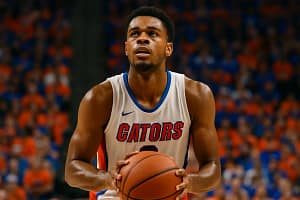
The Thomas Haugh return gave Florida basketball a rare gift before the 2026-27 season had even reached its first official practice. On April 21, 2026, Haugh announced he would stay at the University of Florida for his senior season rather than enter the 2026 NBA Draft, where he had been viewed as a projected lottery pick, according to the Florida announcement. For a program that had just lived through the sharp pain of a 73-72 NCAA Tournament loss to Iowa on March 22, 2026, the decision did more than retain points and rebounds. It preserved an identity.
Haugh was not coming back as a role player hoping to prove he belonged. He returned after a junior season in which he averaged 17.1 points and 6.1 rebounds, led Florida in scoring, led the team in minutes at 33.3 per game, earned first-team All-SEC recognition, and reached consensus All-America status. That profile changed the daily power structure around the Gators. A player who had already carried conference pressure chose another year of college basketball, and that choice set a demanding standard for a roster with major returning production.
That is why this decision matters inside the category that connects Gainesville to the next level. Haugh’s senior year is not a pause in his pro path. It is a college basketball chapter with NBA consequences, team consequences, and community consequences. For readers tracking his broader place in the sport, our earlier look at Thomas Haugh’s college basketball rise adds useful player context.
Why The Thomas Haugh Return Changes The Room
Thomas Haugh Return And The Senior Standard
The Thomas Haugh return placed Florida in unusual program territory. Haugh became one of only four Florida players to return for a senior season after making an All-America team, joining Joakim Noah, Udonis Haslem, and Neal Walk. That list is not just decorative. It says something about the kind of player who can be the best player in the building and still see unfinished work in Gainesville.
For teammates, that matters before anyone discusses sets, matchups, or rotations. A senior scorer who has already been validated by the SEC and national selectors can demand habits without sounding like a player searching for status. He has lived the role. He has absorbed the scouting reports. He has taken the heavy minutes. When a player with that résumé returns, younger teammates and fellow veterans receive a daily example of how serious the next step has to be.
How The NCAA Tournament Loss Reframed The Core
Florida’s 2025-26 team went 27-8, won the SEC regular season title, earned a No. 1 seed in the NCAA Tournament, and still walked out of March with a second-round defeat. The loss to Iowa on March 22, 2026, did not erase the season, but it changed the emotional frame around it. Haugh’s response, as reflected in the research, was direct: he did not want that game to be his last Florida basketball memory.
That kind of motivation can sharpen a team without needing public speeches. It gives the locker room a shared reference point. The Gators do not have to invent pressure for 2026-27. They already know what it felt like to hold a top seed and fall short. Haugh’s choice connected that memory to the next schedule, which should help Florida avoid treating regular-season success as the finish line.
Roster Dynamics Around A Senior Scorer
Five Top Scorers Back In The Plan
The Thomas Haugh return also clarifies Florida’s roster math. The Gators were set to bring back five of their top six scorers from 2025-26: Haugh, Alex Condon, Boogie Fland, Rueben Chinyelu, and Urban Klavzar. Yahoo Sports reported that nearly 90 percent of Florida’s production was returning, a point that framed the roster as unusually experienced entering 2026-27 Yahoo Sports feature.
That continuity is significant in college basketball because it cuts down the amount of early-season teaching that has to be spent on basic trust. Florida’s staff can build from known strengths rather than spend every practice discovering who can handle pressure. Haugh’s presence helps define the top of the scouting report, while the returning group around him gives opponents more than one problem to solve.
- Haugh gives Florida a proven primary scorer and senior voice.
- Condon returns as part of the frontcourt core noted in the research.
- Fland remains one of the returning top scorers from the prior season.
- Chinyelu adds another familiar frontcourt piece.
- Klavzar is part of the returning scoring group from 2025-26.
Why Role Clarity Matters
College teams often lose time when every player is trying to win a new job at once. Florida still had competition to sort through, but Haugh’s return gave the Gators a clear starting point. He was the leading scorer, the minutes leader, and a player whose role had already stretched from interior forward to wing threat. That lets everyone else fit around a known centerpiece rather than wait for a hierarchy to form.
There is also a maturity piece here. Haugh had 1,111 career points at Florida and stood 50th on the program’s all-time scoring list in the research window. A player with that much program equity can connect different roster groups: guards, wings, bigs, returning starters, and players still fighting for larger roles. That is not a small thing on a team carrying expectations from an SEC title and a No. 1 NCAA seed.
Thomas Haugh Return And Florida’s Playing Style

From The Four To The Wing
What makes the Thomas Haugh return especially important is that Florida did not just retain production. It retained positional flexibility. Haugh had moved from a full-time power forward role to more of a wing spot, shifting from the “4” toward the “3.” That move changed the geometry of Florida’s offense. A bigger player operating on the wing forces defenses to decide whether to guard him with size or mobility.
The shooting improvement in the research helps explain why the move was credible. Haugh’s 3-point percentage rose from 25.5 percent as a freshman to 34.0 percent as a sophomore, and he made four of six 3-point attempts in the Elite Eight against Texas Tech. Those facts matter because they show a player whose skill set had already been expanding before his senior decision. Florida did not have to imagine a new version of Haugh from scratch. The evidence was already on film.
Spacing Without Losing The Glass
Haugh’s 6.1 rebounds per game as a junior kept him tied to frontcourt work even as his offensive role stretched outward. That balance gives Florida more lineup choices. If Haugh is used as a wing, the Gators can still keep rebounding size on the floor through other frontcourt pieces. If matchups call for more physical lineups, his background as a power forward gives the staff another way to adjust.
This is where his return changes team dynamics beyond the box score. A wing-sized forward with scoring responsibility can help guards by creating cleaner driving space. He can help bigs by pulling defenders away from the lane. He can help the bench by stabilizing mixed lineups when starters rotate out. None of that guarantees wins, but it gives Florida more ways to survive cold stretches and foul trouble.
What The Thomas Haugh Return Means For Gainesville
A Senior Season With Local Weight
The Thomas Haugh return gave Gainesville something college basketball communities value deeply: a senior season with a real storyline. In an era when many high-level players leave early, Haugh’s choice gave Florida fans a chance to watch a decorated player finish another chapter in orange and blue. That matters to students, alumni, families, and local supporters who build winter routines around Gators basketball.
It also reinforces the program’s connection between development and loyalty. Haugh could have moved straight toward the professional process after All-SEC and All-America recognition. Instead, he chose another year of SEC scouting reports, road crowds, and team accountability. For Florida, that is a recruiting message without needing a slogan: elite players can grow in Gainesville and still see value in staying.
The NBA Track Still Runs Through Gainesville
From a pro-development angle, Haugh’s senior year should be viewed as another evaluation window, not a detour. The research already showed his growth from interior forward to wing, his expanding shooting profile, and his ability to score through SEC play, including 13 games of 20 or more points in 2025-26, with nine of those coming in conference competition. NBA interest did not disappear because he returned. It became tied to how he leads a veteran Florida roster after a painful tournament exit.
That is the core basketball impact. Florida kept its leading scorer, its minutes leader, a rare All-America senior, and a player whose positional growth touches every part of the rotation. The 2026-27 Gators still had to prove their ceiling on the court, but by Aug. 25, 2026, one point was already clear: Haugh’s decision reshaped the room before the first official tip. It gave Florida experience, continuity, and a senior standard that can carry from practice floors in Gainesville to the NBA conversations waiting beyond college basketball.