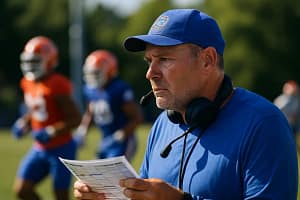
Gators freshmen bigs Domen Petrovic, Arturas Butajevas and Jones Lay did not arrive in Gainesville to be eased into college basketball. On July 17, 2026, Florida’s summer work had already turned into a daily exam, with associate head coach Carlin Hartman holding the young front-court players to a demanding practice standard during midday scrimmages, according to the official Florida report.
That is the right place to start this story. Not with a future box score, not with a promise of early minutes, and not with a recruiting label. The story begins with a coach stopping a possession because a box-out was missed, a switch was late, or a shot did not fit the moment. That is where young big men often find out college basketball is less about height and more about habits.
For Florida, the stakes are different from a rebuilding program handing freshmen all the minutes they can handle. The Gators are deep. That depth can be a blessing for development and a headache for playing time. The young front-court group gets to learn against stronger, older teammates, but the path to the floor is narrow unless practice progress becomes game trust.
Why Gators freshmen bigs Are Being Pushed
Gators freshmen bigs And The Practice Standard
The practice standard described on July 17, 2026, was direct and unforgiving in the best basketball sense. Hartman’s coaching points were not abstract. They were tied to the game: defensive switches, rebounding position, shot selection and the kind of split-second choices that decide whether a possession becomes a stop or a breakdown.
That is the first checkpoint for Gators freshmen bigs: can they process correction while the practice is still moving? A young center can be told in film that he turned his hips too late on a switch. The harder test comes five possessions later, when he has to make the same read with contact in his chest and a guard trying to drag him into space.
Big men usually face the steepest learning curve because every mistake is easy to see. A guard can miss a cut and the action may continue. A front-court player misses a box-out, and the other team gets a second shot. A center is late in drop coverage, and the ball is at the rim. That visibility can be uncomfortable, but it also speeds growth if the player accepts the correction.
The Three-Man Freshman Front Court
Petrovic, Butajevas and Lay give Florida three young front-court bodies with different developmental questions. The research available as of August 27, 2026, does not provide final role projections, playing-time promises or public scrimmage statistics for any of them. That uncertainty matters. It keeps the analysis grounded.
What is clear is that Florida’s staff is not treating the trio as sideline observers. The summer practice notes placed them inside competitive work, not outside it. That means coaches can measure more than skill. They can measure stamina, talk, reaction to mistakes, willingness to hit first on the glass and whether a player can defend one action without forgetting the next assignment.
In a championship-level program, that is how trust gets built. It is rarely one dramatic leap. It is a stack of ordinary plays done right: sprint to the rim, wall up, rebound with two hands, run back, listen, repeat.
The Minutes Squeeze Inside A Deep Rotation
Depth Changes The Freshman Timeline
Florida’s depth is the central tension in this development story. A deep roster can protect freshmen from being forced into roles before they are ready. It can also slow the public side of their growth because fans may not see the day-to-day progress that happens before a player earns a regular shift.
That is not a bad problem for the Gators. It is the kind of problem strong programs create. Young players practice against older players. Coaches do not have to reward potential before habits catch up. The staff can use summer and preseason work to sort out who is ready for live minutes, who needs more strength, and who needs a narrower first role.
For the Gainesville basketball community, patience may be the hardest part. Freshman bigs are easy to dream on because size jumps off the page. But SEC front-court minutes are not won by size alone. They are won by knowing the scout, staying vertical without fouling, finishing through contact and making the simple pass when the defense collapses.
What Role Clarity Means
For Gators freshmen bigs, the quickest path may not be proving they can do everything. It may be proving they can do one or two things every day. A young big who rebounds, protects the rim and survives defensive coverage changes can help a rotation before his full offensive game is ready.
Role clarity also helps coaches. If Petrovic, Butajevas or Lay can be trusted in a specific matchup or practice package, that gives the staff options. Maybe one is stronger on the defensive glass. Maybe one picks up screening angles faster. Maybe one communicates earlier in ball-screen defense. Those details are not small inside a tight rotation.
The best freshman development often starts with subtraction. Take away the extra dribble. Take away the rushed jumper. Take away the late reach after getting beaten. What remains is a cleaner version of the player, one who can stay on the court long enough for the wider skill set to grow.
Building Big Bodies Without Rushing The Process
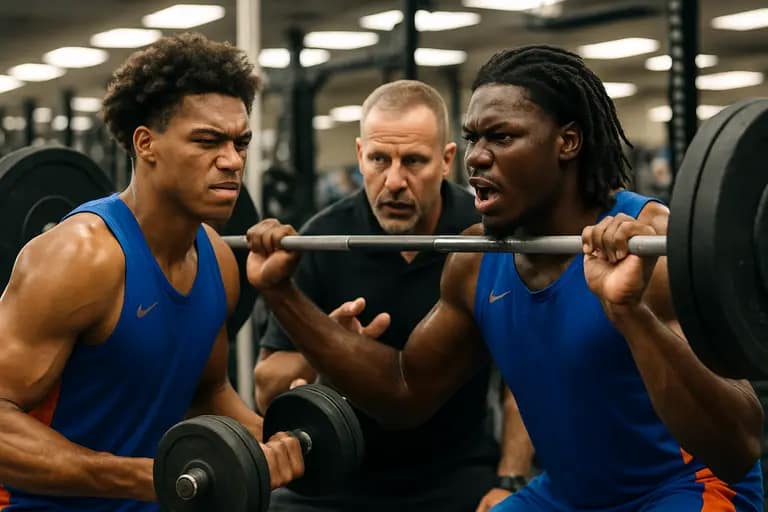
Workload Lessons From Other Programs
Florida’s front-court development does not happen in isolation. Across major college basketball, staffs are trying to build stronger bigs without draining their explosiveness or increasing physical risk. At Michigan, strength and conditioning coach Matt Aldred discussed managing player load during summer planning, including decisions on when to intensify strength work and when to protect movement quality, according to On3’s Michigan report.
That idea fits Florida’s situation. Freshman bigs often need weight-room progress, but basketball is not powerlifting. They still have to sprint, slide, jump, land, absorb contact and recover for the next drill. If the load is too light, they may not be ready for SEC physicality. If it is too heavy at the wrong time, the legs can go flat and skill work suffers.
The smarter path is a steady build. Strength, conditioning, mobility and court reads all have to grow together. Coaches can push hard in practice while support staff track how bodies respond. The public rarely sees that part, but it can decide whether a freshman is ready for a short game stretch in January or still trying to handle the pace.
Skill Expansion Comes After Survival Skills
Modern big men need more than size near the rim. Over time, Florida will want its young front-court players to pass out of pressure, make reads from the elbows, defend in space and finish possessions without needing a play called for them. But first comes survival: stance, contact, rebounding and communication.
That order matters. A freshman center who can shoot but cannot hold a defensive assignment will struggle to earn trust. A forward who can make a face-up move but misses weak-side positioning puts stress on every teammate behind him. The staff’s real-time correction style points toward the foundation: learn the possession before expanding the menu.
- Defensive reliability: switch, recover, wall up and rebound without turning one mistake into two.
- Physical readiness: add strength while keeping the movement needed for college pace.
- Simple offense: screen hard, catch cleanly, finish strong and pass when the help arrives.
- Film carryover: turn a coaching correction from one drill into an automatic response in the next scrimmage.
What Comes Next For Gators freshmen bigs
The path for Gators freshmen bigs after August 27, 2026, is not mysterious, but it is demanding. They have to turn summer correction into preseason consistency, then turn preseason consistency into a role the staff can trust when games arrive. No available report guarantees minutes for Petrovic, Butajevas or Lay, and that is the honest read. Development is visible to coaches long before it becomes visible to fans.
What should the Gator community watch? Not just points. Watch who rebounds in traffic. Watch who talks early on defense. Watch who runs the floor even when he knows the ball may not come. Watch who responds after a coach stops the action. Those are the signs that a freshman big is moving from prospect to dependable teammate.
Florida’s front court has a familiar championship ingredient: internal competition. If the freshmen accept the hard coaching, the payoff may come in stages. Maybe it starts with better practice possessions. Maybe it becomes spot duty. Maybe one player forces his way into a matchup role. The larger win is that the program is asking young bigs to grow up before the scoreboard demands it.